Xtreme Air Services is a specialist, certified Cooling Service provider and also can handle every one of your problems relating to repair service, substitute, tune-ups, and also preventative upkeep. Our qualified air conditioner professionals are very well-informed regarding all makes as well as models and can aid you with all of the new innovative air conditioning technology, and if you have older versions in your home they can give you instructions on what you can do to help with energy efficiency and also updating your unit. Our clients in the Mesquite as well as Dallas location attest us with over 600 5 star examines! You can check us out on our Google page, BBB where we are rated A+, Facebook and Yelp to see numerous excellent reviews on our firm and our friendly team! We value honesty, honesty, as well as a task well done as well as see to it that when our dispatchers respond to the phone and also our service technicians enter into your residence they treat you like part of the Xtreme Air Services household! Our objective is to ensure every little thing looks great and is performing as expected with your system. If we locate any type of problems, we can take care of them as soon as possible rather than waiting for it to trigger you difficulty with our totally equipped trucks. The functionality of an a/c system is to remove the warm from your residence as well as flow it back to the outdoors. How this functions is via the refrigerant taking the unwanted warm in your home via the evaporator coil, the warmth travels through the pipes to the exterior system called the condenser coil, and after that ultimately the fan will certainly blow air over the coil as well as send out the warmth outside where it belongs! https://xtremeairservices.com/trane/furnaces/xc95m/ https://xtremeairservices.com/trane/air-conditioners/xr14/ https://xtremeairservices.com/dallas-air-conditioning/
Andrew Whelton/Purdue University
In the United States, children and adults are increasingly being exposed to harmful chemicals from a source that few people are aware of.
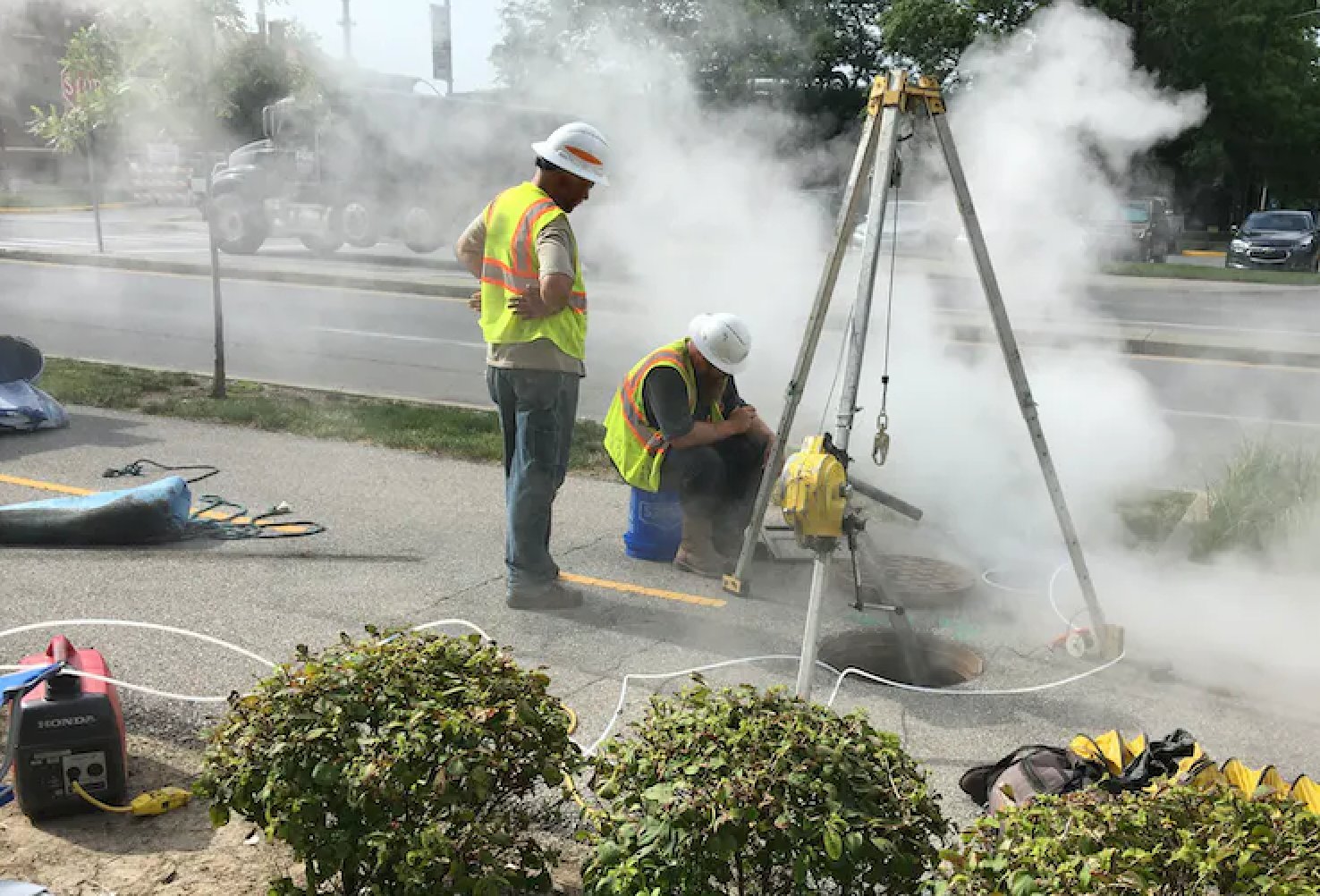
It begins on a street in front of a house or school, where a worker is repairing a sewer pipe in a manhole. The contractor inserts a resin-soaked sleeve into the buried pipe, then heats it, turning the resin into a hard plastic pipe.
This is one of the cheapest and most common pipe repair methods, but it comes with a serious risk: heating the resin creates noxious fumes that can travel down drains and into nearby buildings, sometimes several blocks away.
These chemicals have sickened hundreds of people, forced buildings to evacuate, and even resulted in hospitalizations. Playgrounds, daycares and schools in several states were affected, including Colorado, Connecticut, Massachusetts, Michigan, Pennsylvania, Washington and Wisconsin.
In this sewer pipe repair method, the chemical waste is blown into the air and can enter buildings through underground sewer pipes, plumbing, foundation cracks, windows, doors, and HVAC units. Andrew Whelton/Purdue University
With the bipartisan infrastructure bill of 2022 now sending hundreds of millions of dollars to communities across the US to fix broken pipes, the number of children and adults at risk of exposure is likely to increase.
For more than a decade, my colleagues and I have worked to understand and reduce the risks of this innovative pipe repair technique. In two new studies in the Journal of Environmental Health and Environmental Science and Technology Letters, we show that workers and bystanders, including children, lack adequate protection.
Our research also shows that the technology is safe to use if companies take appropriate action.
Fix aging pipes with harmful chemicals
As US water infrastructure ages, communities across the country are grappling with thousands of broken sewer pipes in their 1.3 million miles of inventory.
The new law earmarks $11 billion for sewer repairs, about a fifth of the EPA’s estimated need.
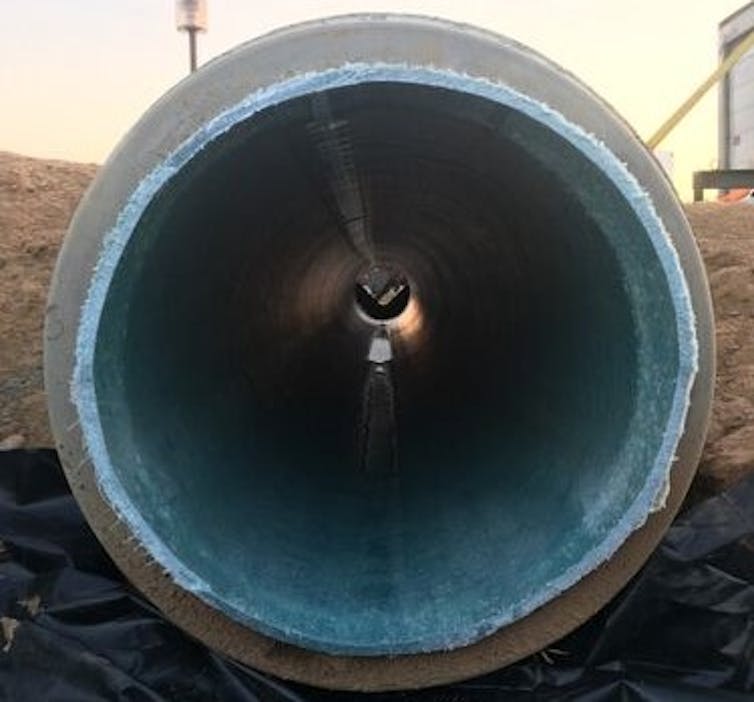
The blue cured-in-place pipe or CIPP can be seen in this damaged storm sewer pipe. The CIPP was made by steam-cooking the resin into the hard plastic. Andrew Whelton/Purdue University
The least expensive repair method is called a cured-in-place pipe, or CIPP. It avoids digging up and replacing pipes. Instead, contractors insert a resin-soaked sleeve down the manhole and through the buried pipe. The resin is then “cooked”, typically with steam or hot water, and turned into a hard plastic.
One challenge is that the safety data sheets for the resins do not disclose all the chemicals, and some completely new ones are created when they are heated.
Chemical plumes rising from nearby contractor manholes and exhaust pipes aren’t just “steam” either. These plumes contain highly concentrated chemical mixtures, uncooked resin, particles and nanoplastics that can harm human health. When we examined the heating process in the lab, we found that up to 9% of the resin was released into the air.
CIPP production is known to release about 40 chemicals. Some cause nausea, headaches, and eye and nose irritation. They can also cause vomiting, breathing difficulties, and other effects.
Waste containing chemicals, uncooked resin, particulates and nanoplastics are released into the air during CIPP manufacturing. This complex emission is not vapor. Andrew Whelton/Purdue University.
Styrene, the most commonly documented chemical, is acutely toxic and “reasonably” carcinogenic, according to the National Research Council. Chemicals other than styrene may be responsible for plume toxicity.
CIPP-associated diseases in nearby buildings
To date, chemical exposures have been reported in at least 32 states and seven countries. This process has contaminated not only schools but homes, restaurants, medical facilities and other businesses. Companies have been cited for exposing their workers to dangerous levels of styrene.
The earliest US incident we know of happened in 1993 at an Austin, Texas animal shelter. Seven people were overwhelmed by smoke and transported to a hospital. In 2001, fumes entered a Tampa, Florida hospital, causing breathing problems for staff. Since then, hundreds more people are known to have been exposed, and the numbers are likely much higher.
In our experience, disclosures are rarely made public. Municipalities have encouraged people affected by the fumes to only contact the CIPP contractor and pipe owner. In some cases, people have been told the exposures are always harmless.
Chemicals can enter buildings through sinks, toilets, cracked foundations, doors, windows, and HVAC systems. The chemicals can even enter buildings that have siphons filled with water. Aware of this risk, passers-by were instructed to cover their toilets and close all windows and doors.
Wind can help dilute the concentration of chemicals outdoors. However, concentrated plumes can enter nearby buildings through buried pipes. Bathroom fans can sometimes increase the concentration of chemicals indoors. Levels found in the buried pipes should prompt firefighters to wear respirators.
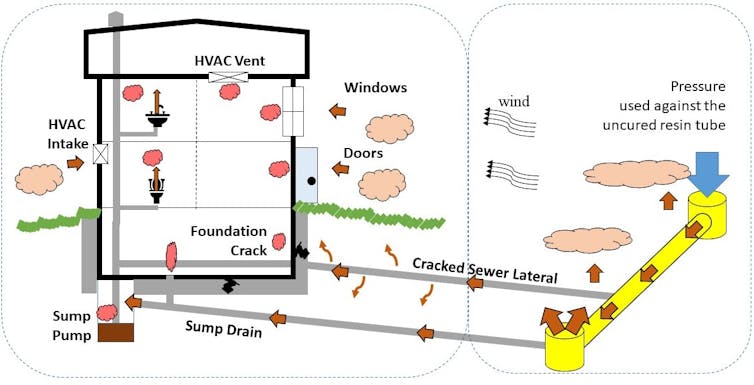
Fumes generated during sewer line repairs on the right can penetrate nearby homes, schools, and other buildings. Andrew Whelton/Purdue University
The highest values were found during and after the heating process.
Hand-held air testers, commonly used by some firefighters and contractors, do not accurately identify specific chemical concentrations. A previous study showed that styrene levels were sometimes a thousand times wrong.
How to protect public health
With the wave of infrastructure projects looming, it is clear that controls are needed to reduce the risk of human harm.
Our research points to several actions residents, businesses, and public health officials can take to keep communities safe.
We advise residents:
-
Close all windows and doors, fill siphons with water and leave the building while pipes are curing, especially if there are children in the building.
-
Report any unusual smell or illness to public health officials or call 911. Get medical advice from health authorities, not contractors or pipe owners. Evacuate building if fumes enter.
Companies can also minimize risks. You can:
-
Stop the cooking process when fumes leave the job site to reduce the spread of contamination and exposure.
-
Use resins that emit less air pollution than standard resins.
-
Ask federal agencies to evaluate the use of portable air testing devices.
-
Capture and treatment of air pollution through the process. While this has not yet been done on a large scale, it is straightforward and would be a fraction of the overall project cost. This waste is dangerous because of its toxicity.
Health and environmental authorities should also get involved. Federal authorities know the practice poses health risks and can be fatal to workers. California and Florida recognize in safety documentation that bystanders may be harmed. However, few steps have been taken to protect the health of workers and bystanders.
This article was republished by The Conversation under a Creative Commons license.
The post Cheap sewer pipe repairs can push toxic fumes into homes and schools – here’s how to lower the risk first appeared on Best Plumbers News.
via Xtreme Air Service https://bestplumbersnews.com/?p=26798






 , attempts to define some of the boundaries of what is reasonable in today’s world. See our editorial guidelines for more information.